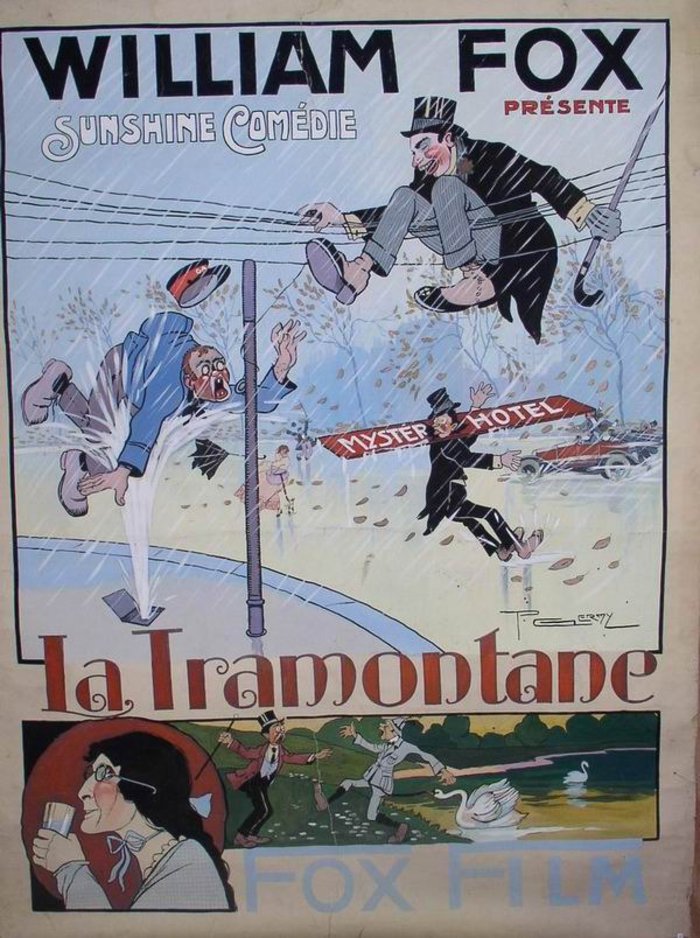
Original maquette: La tramontane William Fox
Original maquette -
By P Germy
, circa 1920, 47.2''x63.0''
, condition: B
Fox Film Corporation was founded in 1915 by pioneer William Fox, through the merger of two companies he had founded in 1913: Greater New York Film Rental, a distribution firm, and the Fox (or Box, according to other sources) Office Attractions Company, a production company. This pairing of distribution and production was one of the earliest examples of vertical integration in the industry. A year earlier, the latter company had distributed Winsor McCay's animated film Gertie the Dinosaur.
Fox initially focused on acquiring and building theatres; film production was secondary. The first studios were set up in Fort Lee, New Jersey, but in 1917 William Fox sent Sol M. Wurtzel to Hollywood, California, to establish a new West Coast studio, the climate there being far better suited to filmmaking. With the advent of sound cinema, Fox acquired rights to the sound-on-film process: in 1925–1926 the company bought the rights to Freeman Harrison Owens's work, the American rights to Tri-Ergon, a system devised by three German inventors, and the work of Theodor Case. With these three patents, Fox created the Movietone process, also known as “Fox Movietone.” Later that year the company began producing films with sound effects, and the following year launched the weekly Fox Movietone News, published until 1963. As its need for space grew, in 1926 the company had to acquire 300 acres (1.2 km²) of land in the countryside west of Beverly Hills and built Movietone City there, the largest film studio of its time.
When Marcus Loew, founder of Metro-Goldwyn-Mayer, died in 1927, Fox offered to buy out his family's holdings: Loew's Inc. then controlled more than 200 theatres as well as the MGM studio (whose films are still distributed internationally by Fox today). Once the family accepted the offer, the merger of Fox and Loew's Inc. was announced in 1929. But MGM's head, Louis B. Mayer, who had not been consulted about the merger, fought back: through his political connections, he had the Department of Justice step in to block the deal. Fortunately for Mayer, William Fox suffered a serious car accident in the summer of 1929 and then lost part of his fortune in the 1929 stock market crash, which put a definitive end to the negotiations.
Deeply in debt and close to bankruptcy, William Fox watched his empire collapse and was even sent to prison. Fox Film, with more than 500 theatres, was placed into receivership. A bank was put in charge of reorganising the company, but it soon became clear that only a merger could ensure its survival. The new owners and president Sidney Kent began negotiations, in early spring 1935, with an independent but highly powerful company, Twentieth Century Pictures.