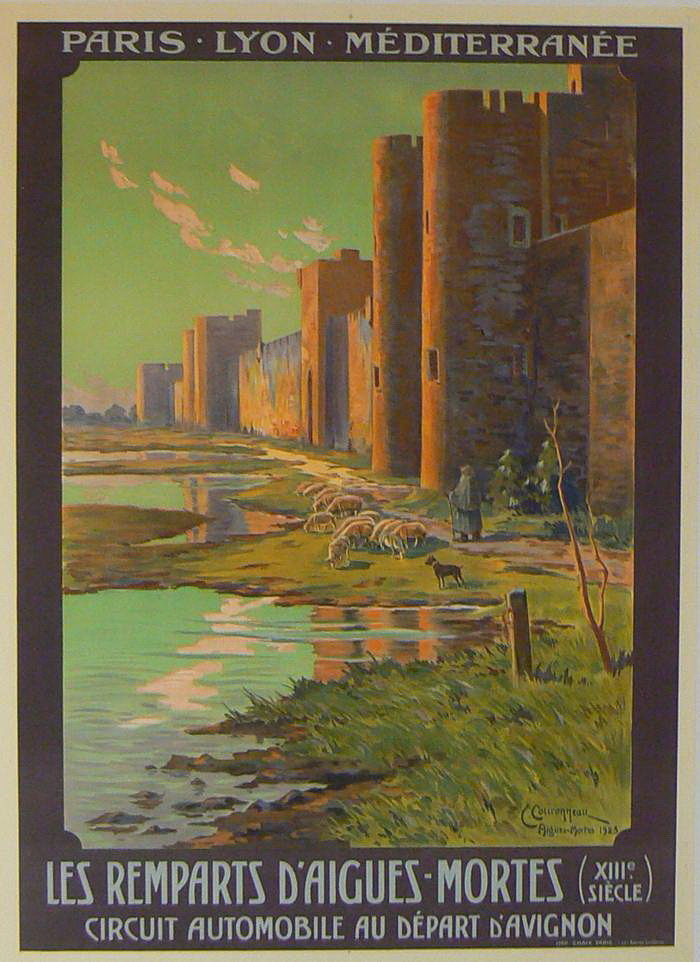
Original lithograph: AIGUES-MORTES PLM
Original lithograph -
By Courronne
, 29.9''x42.1''
, condition: A
In 791, Charlemagne had the Matafère Tower built amid the marshes, to protect the safety of fishermen and salt-marsh workers. Some suggest that signaling and the transmission of news were not unrelated to the construction of this tower, meant to sound the alarm — in the event of an approaching fleet — to the Tour Magne in Nîmes.
The tower's purpose shifted from a military to a spiritual role when Charlemagne granted it to a Benedictine abbey, devoted to the Opus Dei (the work of God), whose ceaseless chanting, day and night, led their monastery to be called Psalmody or Psalmodi. This monastery already existed in 812, as confirmed by a deed of endowment made by Badila of Nîmes to the abbey.
At that time, the inhabitants, who lived in reed huts, made their living from fishing, hunting, and the production of salt from various small salt marshes along the coast. The region was then under the rule of the monks of the Abbey of Psalmodi.
In 1240, Louis IX, wishing to free himself from the grip of the Italian navies over troop transport for the Crusades, took an interest in the strategic position this place offered his kingdom. At that time, Marseille belonged to his brother Charles of Anjou, King of Naples; Agde to the Count of Toulouse; and Montpellier to the King of Aragon. Louis IX wanted direct access to the Mediterranean Sea. He obtained the town and surrounding lands from the abbey's monks through an exchange of properties. In return, the inhabitants were exempted from the gabelle, the tax levied on salt, which they could then take freely.
He built a road across the marshes and erected the Carbonnière Tower there to serve as a watchtower and thus protect access to the town. Saint Louis then built the Constance Tower to house his garrison. In 1272, Louis IX's son and successor, Philip the Bold, ordered the continuation of the ramparts to completely encircle the small town. The work would not be completed for another 30 years.
It was from this town that Louis IX set out twice for the Crusades: the Seventh Crusade in 1248 and the Eighth Crusade in 1270, bound for Tunis, where he died of dysentery.
War memorial.
For many historians, 1270 is wrongly considered the final stage of a process begun at the end of the 11th century. This judgment is hasty, since the transfer of crusaders and mercenaries from the port of Aigues-Mortes continued afterward. The order given in 1275 to the knight Guillaume de Roussillon by Philip III the Bold and Pope Gregory X, following the 1274 Council of Lyon, as reinforcement for Saint-Jean-d'Acre in the East, shows that maritime activity there persisted, in anticipation of a ninth crusade that would never take place. From this 1270 episode comes the popular belief that the sea reached Aigues-Mortes at that time. In fact, as confirmed by the studies of engineer Charles Léon Dombre, the port of Aigues-Mortes as a whole comprised the port itself, located in the Étang de la Marette, along with the Canal-Vieil and the Grau-Louis — the Canal-Vieil being the channel giving access to the sea. It is approximately on the Grau-Louis that La Grande-Motte stands today.
The tower's purpose shifted from a military to a spiritual role when Charlemagne granted it to a Benedictine abbey, devoted to the Opus Dei (the work of God), whose ceaseless chanting, day and night, led their monastery to be called Psalmody or Psalmodi. This monastery already existed in 812, as confirmed by a deed of endowment made by Badila of Nîmes to the abbey.
At that time, the inhabitants, who lived in reed huts, made their living from fishing, hunting, and the production of salt from various small salt marshes along the coast. The region was then under the rule of the monks of the Abbey of Psalmodi.
In 1240, Louis IX, wishing to free himself from the grip of the Italian navies over troop transport for the Crusades, took an interest in the strategic position this place offered his kingdom. At that time, Marseille belonged to his brother Charles of Anjou, King of Naples; Agde to the Count of Toulouse; and Montpellier to the King of Aragon. Louis IX wanted direct access to the Mediterranean Sea. He obtained the town and surrounding lands from the abbey's monks through an exchange of properties. In return, the inhabitants were exempted from the gabelle, the tax levied on salt, which they could then take freely.
He built a road across the marshes and erected the Carbonnière Tower there to serve as a watchtower and thus protect access to the town. Saint Louis then built the Constance Tower to house his garrison. In 1272, Louis IX's son and successor, Philip the Bold, ordered the continuation of the ramparts to completely encircle the small town. The work would not be completed for another 30 years.
It was from this town that Louis IX set out twice for the Crusades: the Seventh Crusade in 1248 and the Eighth Crusade in 1270, bound for Tunis, where he died of dysentery.
War memorial.
For many historians, 1270 is wrongly considered the final stage of a process begun at the end of the 11th century. This judgment is hasty, since the transfer of crusaders and mercenaries from the port of Aigues-Mortes continued afterward. The order given in 1275 to the knight Guillaume de Roussillon by Philip III the Bold and Pope Gregory X, following the 1274 Council of Lyon, as reinforcement for Saint-Jean-d'Acre in the East, shows that maritime activity there persisted, in anticipation of a ninth crusade that would never take place. From this 1270 episode comes the popular belief that the sea reached Aigues-Mortes at that time. In fact, as confirmed by the studies of engineer Charles Léon Dombre, the port of Aigues-Mortes as a whole comprised the port itself, located in the Étang de la Marette, along with the Canal-Vieil and the Grau-Louis — the Canal-Vieil being the channel giving access to the sea. It is approximately on the Grau-Louis that La Grande-Motte stands today.