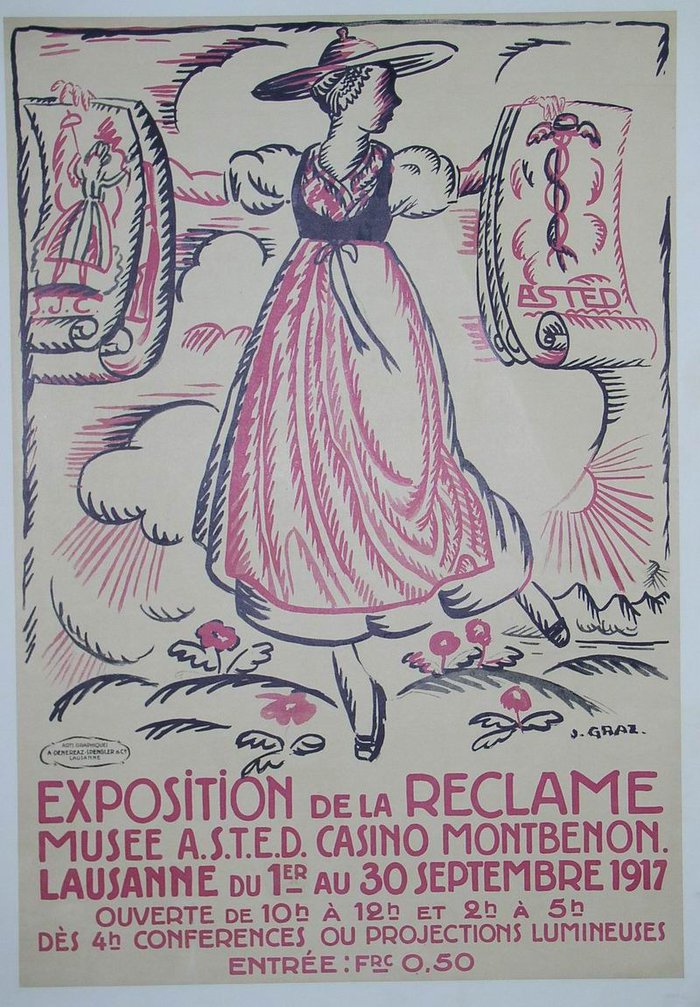
Original lithograph: Exposition de la réclame
Original lithograph -
By Graz
, 27.0''x39.2''
, condition: A
Inhabited since prehistoric times, it was nonetheless in the Celtic era, chiefly through the Helvetii, that Swiss territory entered recorded history. Incorporated into the Roman Empire in the 1st century BC, Switzerland remained Gallo-Roman until the 5th century, when, already largely Christianised, it was occupied by the Burgundians and the Alamanni.
Successively incorporated into the Burgundian and Frankish kingdoms and then the Carolingian empire, it was attached in the 11th century, on the fall of the Kingdom of Transjurane Burgundy, to the Holy Roman Empire, becoming the stage for feudal conflicts.
The year 1291 was chosen as the founding date: it marks the alliance of three cantons controlling the newly developed Gotthard route — Uri, Schwyz and Unterwalden. These cantons confirmed their desire for independence at the Battle of Morgarten in 1315.
The neighbouring territories of Lucerne, Zurich, Glarus and Zug joined them in the 14th century, forming what is now known as the Confederation of Eight Cantons. The 15th century saw a series of conquests that brought the Confederation to the Rhine and to French-speaking Switzerland, while it formed alliances with surrounding territories (Valais, Appenzell, St. Gallen, the Grey Leagues, Fribourg). It eventually took part in the Burgundian Wars. Finally, following the Swabian War of 1499, the cantons became de facto independent of the Holy Roman Empire; this independence was only formally recognised at the Peace of Westphalia in 1648.
The late 15th century saw an early conflict between towns and rural areas, resolved by the Stans Agreement of 1481, thanks to Nicholas of Flüe; this opened the way for five new cantons: Fribourg, Solothurn, Appenzell, Basel and Schaffhausen. Thus, at the start of the 16th century, the Confederation of Thirteen Cantons was born, strengthening its local alliances (Biel, St. Gallen, Neuchâtel) and extending its possessions into Ticino and the canton of Vaud. Then came the Italian Wars, and above all the Battle of Marignano (1515): from then on, it was only as mercenaries that the Swiss would still make their mark on European battlefields.
Torn apart by the Reformation, Switzerland was consumed by the Wars of Religion (the First War of Kappel in 1529, narrowly avoided through the famous “milk soup” episode; the Second War of Kappel in 1531; the First War of Villmergen in 1656; the Second War of Villmergen in 1712), which dominated domestic politics; the early democracy gave way to oligarchic governments blocking all reform.
The French invasion of 1798 freed the subject territories and profoundly transformed Switzerland into a unitary state, the Helvetic Republic. Faced with constant unrest, Napoleon imposed the Act of Mediation in 1803, restoring the cantons (with Vaud, Aargau, Thurgau and St. Gallen becoming full cantons) while detaching Neuchâtel, Geneva and Valais, which became briefly independent again before being absorbed into the Empire.
In 1814 and 1815, the Restoration created a first federal state of twenty-two cantons; the struggles between conservatives and radical liberals culminated in the Sonderbund War of 1847 and the victory of the latter. The end of the century saw the emergence of the federal state, which abolished internal borders and imposed a single currency and a federal army. The 1848 Constitution was revised in 1874, adding the right of referendum.
The early 20th century continued this legislative work: a penal code and then a federal civil code were created, and the right of constitutional initiative was introduced.
Thanks to its neutral status, Switzerland escaped both world wars and gradually became host to numerous international organisations, while joining international bodies only sparingly (the Council of Europe in 1963, the United Nations in 2002).
Switzerland joined the United Nations on 10 September 2002, but has so far always declined to join the European Union.