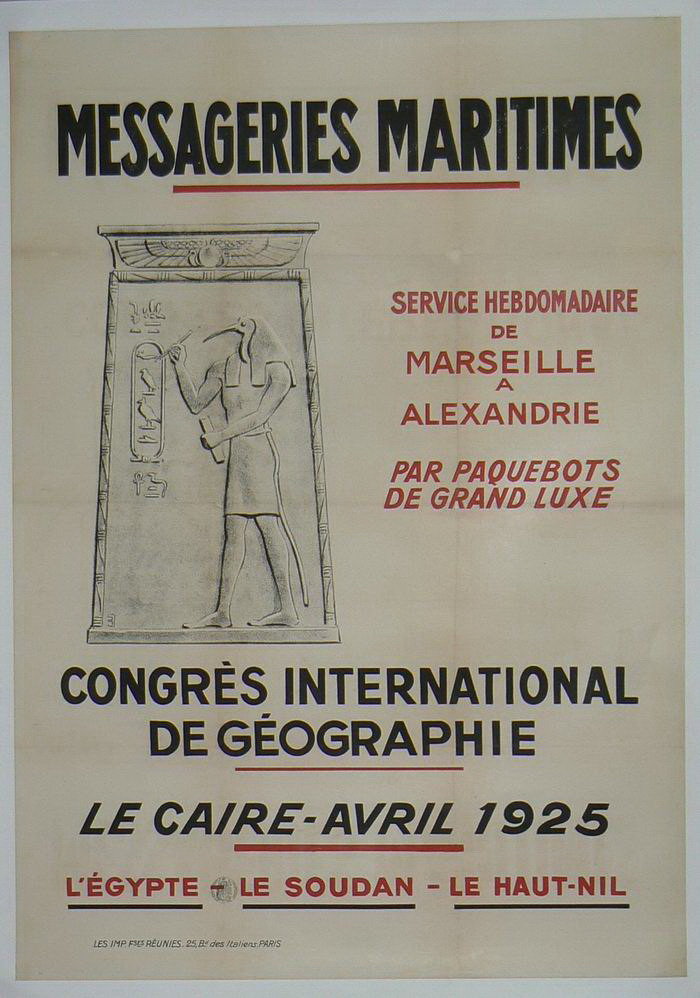
Original lithograph: Messageries Maritimes Cairo 1925
Original lithograph -
Anonymous
, 29.5''x41.7''
, condition: A
Weekly service from Marseille to Alexandria. International Congress of Geography. Cairo, April 1925. Imp. Françaises Réunies, Paris. Egypt, Sudan, the Upper Nile.
The Cairo International Congress of Geography
The Cairo Congress was held in April 1925 on the initiative of King Fuad (1868–1936): “On the occasion of the forthcoming fiftieth anniversary of the Royal Geographical Society of Egypt, founded in 1875 by Our illustrious father the Khedive Ismail, it has pleased Us to mark this event by inviting the 11th International Congress of Geography and Ethnology to hold its sessions in Cairo in 1925” (Congress, 1925: 2). Invitations for the occasion went out to both learned societies and governments.
A special correspondence took place with Italy, which had organised the previous International Congress of Geography in Rome. At its session of 10 June 1922, the Executive Commission of the Rome Congress decided to hand over to the Egyptian Commission full authority over the organisation of the forthcoming congress. Egypt had to join the newly created International Geographical Union, under whose patronage future congresses were to be held. The union's president was at the time Prince Bonaparte, a member of the Institut de France; he was later succeeded by the Italian general Nicola Vacchielli.
The Congress received 29 delegations, 18 of which included a government delegation led by a scholar or a diplomat. There were official dinners and excursions. One of the Congress sessions was held in Alexandria. Books and maps were presented to the Royal Geographical Society of Cairo. The King awarded decorations to participants: General Nicola Vacchielli received the Grand Cordon of the Order of the Nile, and Adolphe Cattaui Bey (then Secretary General of the Cairo Geographical Society) was made a Grand Officer of the same order, as was Paul Pelliot, head of the French delegation.
We have the text of the main speeches given during the Congress's official proceedings. They combine scholarly concerns with political preoccupations (diplomatic recognition, national pride, praise for modernisation).
The Cairo Congress was held in April 1925 on the initiative of King Fuad (1868–1936): “On the occasion of the forthcoming fiftieth anniversary of the Royal Geographical Society of Egypt, founded in 1875 by Our illustrious father the Khedive Ismail, it has pleased Us to mark this event by inviting the 11th International Congress of Geography and Ethnology to hold its sessions in Cairo in 1925” (Congress, 1925: 2). Invitations for the occasion went out to both learned societies and governments.
A special correspondence took place with Italy, which had organised the previous International Congress of Geography in Rome. At its session of 10 June 1922, the Executive Commission of the Rome Congress decided to hand over to the Egyptian Commission full authority over the organisation of the forthcoming congress. Egypt had to join the newly created International Geographical Union, under whose patronage future congresses were to be held. The union's president was at the time Prince Bonaparte, a member of the Institut de France; he was later succeeded by the Italian general Nicola Vacchielli.
The Congress received 29 delegations, 18 of which included a government delegation led by a scholar or a diplomat. There were official dinners and excursions. One of the Congress sessions was held in Alexandria. Books and maps were presented to the Royal Geographical Society of Cairo. The King awarded decorations to participants: General Nicola Vacchielli received the Grand Cordon of the Order of the Nile, and Adolphe Cattaui Bey (then Secretary General of the Cairo Geographical Society) was made a Grand Officer of the same order, as was Paul Pelliot, head of the French delegation.
We have the text of the main speeches given during the Congress's official proceedings. They combine scholarly concerns with political preoccupations (diplomatic recognition, national pride, praise for modernisation).